
French fries are undoubtedly the most popular side dish worldwide, and the secret to their success lies in a consistently sized and shaped cut that ensures even cooking and a perfect texture. Whether you're a restaurant owner aiming to serve thousands of meals daily, or a home cook looking to save time and effort, finding the best potato cutter is a crucial step towards achieving efficiency and quality.
Gone are the days of messy, time-consuming, and uneven hand-cutting that affects the final dish. In this professional and in-depth guide, we'll review the different types of potato slicers available on the market and analyze the specifications of appliances designed for home use versus those intended for commercial and restaurant use. We'll provide objective comparisons supported by practical examples, enabling you to choose the tool that will not only save you time but also elevate your dishes to professional levels. Get ready to discover the tool that will revolutionize the way you prepare potatoes!
What is the best potato slicer? Quality and professionalism standards
Choosing the best potato slicer depends primarily on its intended use (home or commercial) and the features that matter to the user. There is no single slicer that suits everyone, but there are some basic criteria to consider:
1. Blade quality (the blade is the heart)
- Material: The blades must be made of high-quality stainless steel . This ensures the required sharpness for smooth cutting without breaking the potatoes, and resists rust and corrosion caused by repeated potato starch removal.
- Strength and stability: In manual potato slicers, the blade mesh must be strong enough to withstand the pressing pressure without bending or becoming deformed, especially with large or hard potatoes.
2. The structure of the cutter (durability and stability)
- For home use: The sections can be made of durable plastic materials with rubber bases to increase stability.
- For professional use (restaurants): The frame must be made entirely of stainless steel or heavy iron to ensure it can withstand repeated operations and the high mechanical energy of pressing or electric operation. (Example: Professional manual potato slicer with a stainless steel frame [1]).
3. Easy to use and clean
- Operating mechanism: Whether manual (press or pull) or electric, the mechanism must be simple and efficient. Manual cutters with a pressing system are preferred for their speed.
- Cleaning: All parts, especially the blades, should be easy to disassemble, assemble, and clean. Potatoes contain starch, which dries and hardens easily, so easy blade cleaning is crucial for maintaining the tool's lifespan.
4. Cutting options (shapes and sizes)
The required shapes for potatoes vary:
- French fries: The most common size. It's best to choose cutters that come with different blade sizes (usually at least two different sizes).
- Crinkle Cut: For an attractive and unique shape. Requires special crinkle blades (example: Noon crinkle cutter [7]).
- Sliced or diced potatoes: These are provided by some multi-functional manual slicers.
What are the different types of potato slicers? A detailed functional classification
Potato cutting machines can be classified into three main types covering all market needs, from home kitchens to fast production lines.
1. Manual Plunger Choppers
- The mechanism: It relies on the user's pushing force. The potato is placed in position, then forcefully pressed using an arm or handle to push the potato through the stainless steel blade network.
- Usage: Excellent for homes and small businesses that need moderate quantities on a regular basis.
- Advantages: Relative speed, uniformity of cutting size, no need for electricity.
- Examples:
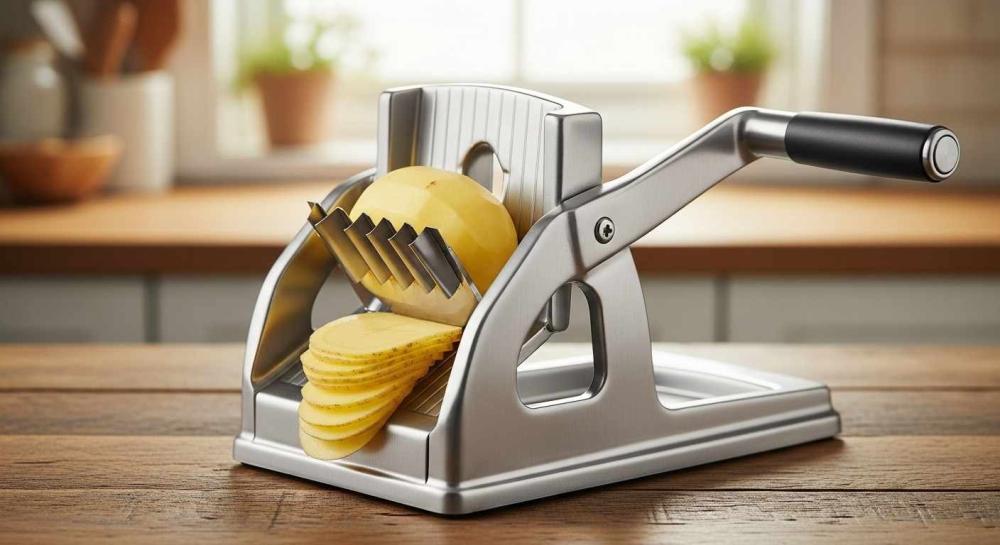
- Professional manual slicer (stainless steel body): It is highly durable and suitable for light commercial use. [1]
- Pakistani manual press cutter (heavy iron): Known in the markets for its superior durability and ability to withstand high pressure. [5]
2. Specialty Manual Cutters
- Mechanism: Simpler tools used to cut specific shapes.
- Usage: Home kitchens that want variety in the presentation.
- Advantages: Inexpensive, easy to use, aesthetic results.
- Examples:
- Crinkle Cutter: A wavy knife used to cut potatoes into wavy shapes; it is an easy process that does not require much pressure. [7]
3. Electric Potato Slicers
- The mechanism: It relies on an electric motor to push the potatoes through rotating blades or fixed grids.
- Usage: Designed for heavy commercial use (restaurants, hotels, small factories).
- Advantages: High speed, cutting huge quantities, reducing human effort.
- Challenges: Requires regular maintenance, is more expensive, and consumes more space.
The best electric potato slicer: Unmatched power for commercial projects
If you run a restaurant or a French fry business, efficiency and productivity are key to profitability. This is where the importance of an electric potato slicer comes in.
Golden Ice electric potato slicer
Golden Ice slicers are an example of commercial equipment relied upon by restaurants, and they feature the following specifications:
| Professional Feature | Details and benefits |
| High productivity | Designed for continuous and rapid cutting of large quantities, eliminating stoppages in the production line. |
| Strong structure | Made from durable materials (often commercial stainless steel) to withstand long hours of operation and continuous pressure. |
| Saving time and effort | It cuts in seconds without any physical effort, thus increasing the speed of service. |
| Blade options | It usually comes with a set of interchangeable blades for different sizes and shapes of potatoes (fingers, slices). |
Depth analysis:
Investing in an electric potato slicer is a sound business decision. Despite the initial cost, it significantly reduces labor costs and ensures product consistency, a crucial factor for customer satisfaction in the food industry. It's the ideal choice for those seeking the best potato slicer for restaurants.
The best manual potato slicer: Home precision and durability
Manual potato slicers are the ideal solution for home kitchens and light commercial uses that do not require huge quantities, with a focus on efficiency and durability.
1. Professional manual slicer (stainless steel body)
This category is best for the modern home and the chef who cooks frequently:
- Design: A solid stainless steel frame provides stability during pressing, and very sharp blades for smooth cutting.
- Sizes: They usually come with two weapons (blades) of different sizes (e.g., 1/2 inch and 3/8 inch) to offer two finger size options.
- Practical application: It can be mounted on the work surface, requires one strong press to cut a whole potato uniformly, and provides results that far surpass manual cutting.
2. Manual potato slicer (heavy-duty material)
These models, such as the "Pakistani Manual Press Potato Cutter" made of heavy-duty cast iron , are renowned for their exceptional durability:
- Maximum durability: Its heavy-duty design makes it resistant to breakage and wear even with repeated use for many years.
- Strength: The ability to handle large potatoes without requiring much physical effort compared to lighter models.
- User tip: It is important to clean and dry them thoroughly after use, especially if they are made of treated iron, to maintain their appearance and prevent rust.
Summary for manual sectors:
If your goal is the best manual potato slicer, you should focus on the durability of the frame (stainless steel or heavy iron) and the quality of the stainless steel blades, which should be interchangeable, to ensure speed and accuracy in your home kitchen.
Best potato slicer for restaurants and commercial projects
Restaurant requirements differ radically from those of a home kitchen. It's about speed, consistency, and size. A slicer must meet three basic criteria:
1. Productivity and Capacity (Volume and Throughput)
- Maximum productivity: The slicer must be able to slice at least 100 kilograms of potatoes per hour.
- Electric is best: Electric slicers (such as Golden Ice commercial models) are the only option. Some large restaurants also rely on automatic potato peelers (for example, a 30 kg peeler) as a first step before electric slicing.
2. Industrial Grade Design and Durability
- Materials: Heavy-Duty Stainless Steel is used in all food contact parts and the outer casing.
- Stability: It must be designed for stable installation or have heavy, anti-slip bases to withstand the vibrations of repeated operation.
3. Safety and Hygiene
- Safety: Given its speed and power, it must have advanced safety features to prevent accidents.
- Health: Ease of disassembly and sterilization is paramount to maintaining the hygiene standards followed in restaurants.
An example of a smart choice for small restaurants:
For newly established restaurants or food trucks that do not require very high productivity, a professional manual potato slicer with a stainless steel body can be a reliable, cost-effective, and temporary solution, especially with staff being trained to use it efficiently.
To enhance the article's credibility and search engine ranking, we answer the most frequently asked questions about cutting potatoes:
1. Can a potato slicer slice other vegetables?
Yes, most manual potato slicers can cut other root vegetables like carrots, sweet potatoes, and some other firm vegetables into sticks, but they may require more pressure. Multi-purpose slicers (like the popular Nicer Dicer slicers) are designed to slice onions, tomatoes, and cucumbers too, but they may not be as efficient as a dedicated potato slicer.
2. How do I keep the blades of my potato slicer sharp?
The most important factor is immediate cleaning. After chopping, the blades should be disassembled and washed immediately to remove any remaining starch. The blades must be thoroughly dried before storage to prevent rust. Blades made of good quality stainless steel do not require frequent sharpening.
3. What is the best size for French fries?
The most common and universally preferred size is 3/8 inch (approximately 9.5 mm) , a medium size that strikes a balance between a crispy exterior and a soft interior. Smaller sizes (1/4 inch) produce thinner, crispier potatoes, while larger sizes (1/2 inch) are suitable for steak potatoes.
In this comprehensive guide, we've provided a clear roadmap for choosing the best potato slicer , whether you're looking for everyday efficiency in your home kitchen or high productivity in a commercial establishment. We've seen how electric slicers (like Golden Ice) excel in the speed race for restaurants, and how heavy-duty manual slicers (like stainless steel and heavy cast iron) shine in the precision and durability for medium-duty use.
Choosing the right tool is an investment in your time and the quality of your food. Don't settle for uneven potato wedges anymore! Consistency is the secret to perfectly cooked and crispy potatoes that everyone craves.
Don't hesitate to take the next step. Determine your daily potato requirements and weigh the durability of the body (stainless steel/heavy-duty iron) against the quality of the blades. Click here to browse the latest models of manual and electric potato slicers available on the market and start serving professional-looking and perfectly tasting fries!